Showing posts sorted by date for query son. Sort by relevance Show all posts

Sunday, December 13, 2020

"Come and Find the Quiet Center"

Sermon given Sunday, December 13, 2020 for Magic ValleyUnitarian Universalist Fellowship Zoom Worship Service

I am so grateful to be here with you virtually today and look forward to the time when we can be together again in physical space. Thank you for giving me this opportunity to share my thoughts about this month’s theme: stillness.

Like many of us during this year of global pandemic and tremendous change, I have begun to categorize my life into the Before Time and the Now. As some background, I’m a mother of four children (two in college, two still in high school), a wife, a community college English professor, and a mental health advocate.

For many years, the one constant in my life has been chaos. I’m betting more than a few of you can relate. What was your life like in the Before Time?

Then COVID-19 came—and before we get too far, I have a confession to make. The pandemic was definitely all my fault. No, really! Let me explain.

Here’s what my calendar looked like in the last week before everything changed.

On Saturday, March 7, I attended the Depressed Cake Shop fundraiser for Boise’s Interfaith Sanctuary homeless shelter and connected with my dear friend and fellow mental health advocate Valerie Van Gelder and her sister and equally dear friend Jodi Peterson, director of Interfaith Sanctuary. My children and I had baked “depressed Oreos” for the event—sad looking dark chocolate cookies with grey cream cheese frosting filling, but when you bit into them, you saw a rainbow of cheery pinks and blues and yellows, reminding us that mental illness doesn’t define who we are.

That evening, I attended the Idaho Democratic Party’s gala. When I bought my tickets, I had been over the moon at the thought of hearing Mayor Pete, then ecstatic over the prospect of Elizabeth Warren, then when they both cancelled, I was just happy to attend and catch up with good friends. Remember when we could hang out together? took my last groupies that night, and now, it seems like another world to me when I look at those photos. We were all so physically close! None of us was wearing a mask! (It was a wonderful night).

On Sunday, March 8, I attended what would be the last in-person service of the Boise Unitarian Universalist Fellowship. There were murmurs then about COVID—cases popping up in Seattle and New York—but here in Idaho, nothing seemed out of place just yet.

On Monday, March 9, my 48th birthday, I taught my usual English classes at the College of Western Idaho, and my sweetheart took me out to Rice, one of my favorite Asian restaurants, for what would turn out to be my last supper inside a restaurant in 2020.

On Tuesday, March 10, I hosted a Mayan archaeologist for a guest lecture at the College of Western Idaho for my survey of world mythology students. More than 30 students and community members attended. We passed around a heavy rubber ball used in pok a tok, the traditional Mayan ball game that figures heavily in the Mayan creation story.

A week later, we would learn that someone in the building that night with us had tested positive for COVID 19.

On Wednesday, March 11 my students were beginning to ask questions—and I did not have answers. I blithely told them not to worry—that if we went online, I had years of online teaching experience and would be able to support them during the few weeks we would not be able to attend class together.

That night, I attended what would be my last in person choir rehearsal at BUUF—and realized to my horror that I had accidentally double booked myself for the coming March 15 Sunday services.

And here’s why the pandemic with all its chaos is my fault. I had said yes to playing for BUUF’s choir and to playing the organ at my children’s Mormon church—at exactly the same time! Reverend Sara, the music director, and I began a frantic flurry of emails trying to come up with a new order of service that would allow me to play at one church before racing up the road to the other one. But no matter how we looked at it, the logistics problem seemed insoluble. It looked like I would have to let someone down and accept the consequences of my poor planning.

So in desperation, I prayed to whatever gods may be that somehow I could get out of the mess I had created for myself. And here we are.

On Thursday, March 12, I taught what would be my last in-person classes—the last time I stepped onto CWI’s campus--until the Fall semester of 2020. That night, I attended my son’s last minute choir concert at Northwest Nazarene University. His choir had been chosen from all the high school choirs in the Pacific Northwest to perform at the American Choral Directors Association annual meeting—which had abruptly been cancelled earlier that week because of fears about the pandemic.

So the choir sang for us instead. The director joked (with foresight, it turns out) that it was probably the last time singing like this would be legal for a while. In case you haven’t heard, it turns out choir is pretty much the perfect superspreader event.

The music that night was exquisite, and tears ran down my cheeks as these high school students whose entire world was about to change began with their signature piece, a hymn called “Come and Find the Quiet Center.” We’ll come back to that hymn in a minute, but for now, let’s continue through the last week of my Before Time.

On Friday, March 13—Friday the thirteenth (haha). I learned that my college had decided to start Spring Break early and extend the break for three weeks. That three-week break turned into five months—and while I have returned to campus to teach a few in person classes, wearing a mask and socially distanced, of course, most of my colleagues are still working remotely.

On Saturday, March 14, the big Latter-day Saint mental health conference I had been looking forward to attending, featuring former Brigham Young University quarterback Tanner Mangum, was cancelled. That afternoon, I went to the fabric store and purchased cotton prints and flannel backing to make masks. It was the last time I would set foot in any store other than a grocery store for a while.

And on Sunday, March 15, the gods answered my desperate prayer. I was no longer double booked because everything was cancelled! Everything that day, and the next day, and the next, stretching into months, was cancelled.

What could this mean? At first, we all thought it would be a few weeks. Then we thought, maybe a few months. Then we realized the awful truth: 2020 was cancelled.

And just like that, I had the one thing I could never find enough of: time.

So I sewed masks. Like many of you, I baked—a lot—and thought about planting my garden. I developed a daily practice of taking long solitary walks around my neighborhood.

During my walks, the hymn my son’s choir sang would often fill my mind. I want to share the words with you.

“Come and Find the Quiet Center” by Shirley Erena Murray

Come and find the quiet center in the crowded life we lead.
Find the room for hope to enter, find the frame where we are freed.
Clear the chaos and the clutter, clear our eyes that we can see
all the things that really matter, be at peace and simply be.

And I wondered, What is so hard about stillness anyway? Why is it so hard to “be at peace and simply be”? The answer is not an easy one. In the sudden enforced quiet, we—all of us—have been forced to face the truth of our own mortality. We might get sick and die, or we might not. Our loved ones might get sick and die, or they might not. But we all have to face the truth: none of us gets out of here alive. We are powerless over life and death.

Some people turn to religion in times like these. We may think of Jesus calming the wind, the waves, and his disciples’ fears with a simple command: “Peace, be still.” Or we may think of the Biblical seventh day, the Sabbath, a day created specifically for rest and contemplation of the Divine.

Or our thoughts may turn to the Jewish tradition, especially during this week of Hanukkah. Speaking of another sacred day, Yom Kippur, the “Sabbath of Sabbaths” and holiest day in the Jewish calendar, Rabbi Marc Margolius of the West End Synagogue in New York City wrote that stillness is “the quintessence of Yom Kippur itself: the necessity for human beings to be, rather than to do; the necessity to be still, rather than to speak; the necessity to seek out the authentic and eternal, not the artificial or temporal.”

Rabbi Margolius further observes that “Some of Judaism’s most powerful religious metaphors are internal; they invite us to seek God not atop a mountain or in heaven, but within ourselves.”

Have you climbed mountains seeking something? I have. But these days, I am spending more time seeking God within myself.

In yoga, the hardest posture for me is savasana, corpse pose, where we lie silent and still on our mats. It’s also the most essential-part of my daily practice: to quiet my busy brain, to say “Peace: Be Still.” I have found that as I focus on being instead of thinking or doing, I can feel myself connected to the world in marvelous ways, experiencing what it means to exist in the glorious eternal now.

This time of enforced quiet has definitely not been all fun and games though. In the stillness, I learned some hard things about myself. I learned first that I was tired. We are all so tired. Living with mundane, quotidian existential dread has a way of doing that to us. From pandemics to politics, our poor limbic systems are stuck in panic mode.

I don’t know about you, but I’m taking antidepressants and doing tons of telehealth therapy to cope with even little things like grocery shopping right now. As a mental health advocate, I know there’s no shame in this. These times are hard, and I’m grateful that there is help, and that I can access it.

But I’m also focusing on my breath. At its simplest, breathing is the essence of existence. And as we breathe, we can “Clear the chaos and the clutter” so that we can see what really matters to us. As I have seen what really matters to me, I have experienced a profound sense of gratitude.

In the stillness, the second hard lesson I learned was that any sense of control is an illusion. In the Before Time, I thought that I was the master of my own fate. I tricked myself with Outlook calendars and social media and other tools of modern existence into believing that I could control what happened to me or to the people I loved. I can’t. You can’t. To “find the frame where we are freed,” we must first free ourselves from this illusion of control.

On my daily walks last spring, I began to develop what the poet Amy Clampitt called “a limitless interiority” where anything seemed possible. I watched ducklings grow from balls of yellow fuzz to mature confident adults. I watched buds swell on tree branches and slowly unfold their petals to the sun. Every day, a few more blossoms opened until the trees were splashes of pink and white against the blue spring sky. Those buds were hope. I watched as the blossoms faded, the trees greened then turned to gold. The leaves carpeted the sidewalks, and still we waited.

In the traditional Christian liturgical calendar, December is a time of waiting. During advent, Christians wait each year for the birth of their god in human form.

(Fun and slightly sacrilegious fact from Life Hacker Joel Cunningham—if you buy an advent calendar the day after Christmas this year, it will count down the days to Joe Biden and Kamala Harris’s inauguration). 

But seriously, when you think about it, isn’t hope for a better world, in its simplest form, at the heart of religion? We are called, all of us, in this season of waiting, of hope, of light, to “Come and find our quiet center.”

My children and my students keep asking me when we will return to normal. I have good tidings for them—and for you: We won’t.

In mental health advocacy, we have a saying: “Normal is a setting on the washing machine.” If we’re lucky, we’ll emerge from this time of stillness with something important to say and do. When our eyes are opened to the things that really matter—to social justice and equity for our Black and Brown brothers and sisters, to stewardship for our fragile earth, to the future we want to leave our children and their children—we will “find the room for hope to enter.”

But most importantly, if we’ve learned the lessons of these challenging times, we’ll enter our new world, whatever it looks like, secure in the knowledge of how to return to our quiet centers, “to be at peace, and simply be.” That peace is my wish for myself and for all of you, in this season of waiting, of stillness, of hope, joy, and light.

Closing Song

Bothell High School "Come and Find the Quiet Center" arranged by Kirk Marcy

Or my son’s Sonous choir directed by Seth McMullen: at minute marker 28:10-30:35 

Reading: From “A Silence” by Amy Clampitt

past parentage or gender
beyond sung vocables
the slipped-between
the so infinitesimal
fault line
a limitless interiority

beyond the woven
unicorn    the maiden
(man-carved    worm-eaten)
God at her hip
incipient
the untransfigured
cottontail
bluebell and primrose
growing wild     a strawberry
chagrin     night terrors
past the earthlit
unearthly masquerade

(we shall be changed)

a silence opens


#lighttheworld

Saturday, March 14, 2020

Online Teaching 101

Ready or Not, the Future Is Now—and It Doesn’t Have to Be Dystopian
Photo by bongkarn thanyakij from Pexels

Many of us in higher education received emails last week about either taking our classes online or preparing to do so. If you’re anxious about the next several weeks, imagine how your students are feeling! Many of them have avoided online classes or have had a negative experience with one in the past. For context, I teach hybrid, face-to-face, and online classes in an open-access community college where many of my students are already at risk, and last week, I could smell the fear. 

As a teacher, you are likely well aware that current research about online education suggests that distance learning is not as effective as face-to-face classes and that the retention and persistence rates for students are poor. Also, let’s be frank here: some administrators seem to think that online classes are “easy” to teach and that all we have to do is post our syllabus online to turn a face-to-face class into an online one.

Nothing could be further from the truth, and you should be aware upfront that developing and teaching an online course, in my experience, typically takes more time than teaching a face-to-face class (though it comes with added perks like flexibility and the ability to offer classes during a pandemic). For this reason, it’s important to track your labor over the next few weeks.

With those caveats, I want you to know how much I personally love teaching and learning online. As an instructor who began teaching online and hybrid classes in 2010 and completed my Organizational Leadership doctorate in a fully online program in 2016, I have seen firsthand that online teachers can create effective active learning opportunities. With intentional planning and deliberate outreach, an online class can provide a robust learning environment for your students.

Below, I have outlined a few areas that have been important to me as an online teacher, along with examples and resources. I have focused my suggestions on relatively simple and quick ways to transfer your existing face-to-face class to an online environment.

Communicate Early and Often
One of the most important ways to build engagement with online students is to communicate early and often. Communication should take a variety of forms, and make sure you let your students know what your preferred style of communication is. Here’s how I communicate with my classes:
  • Weekly LMS course announcements about assignments, sometimes including a short video I record on my phone and upload to YouTube.  
  • Regular and frequent emails, including a weekly email wrap up of the work we covered. Note: it’s important to make sure that students are checking their student email. Including a tutorial about how to forward their student emails to their phones can be a great way to make sure that they are checking their messages. It’s also really important that you respond to emails as quickly as possible, but definitely within 24 hours. I check for student emails before I go to bed every evening and when I wake up in the morning. Here is an example of a weekly wrap up course announcement/email I created for my English 215 Survey of World Mythology course:


  • “Ask Your Instructor” open forum in your LMS discussion board. Students can post questions that the whole class may have. Subscribe to this board so that you can get back to students quickly. 
  • Video feedback on assignment grades. Both Canvas and Blackboard make this easy to do by incorporating a way to record audio or video feedback directly in the assignment comment box. This way of giving feedback has two advantages: 1) It generally takes less time than line edits or written feedback, and 2) It builds rapport with your students. They will feel like you really care, which will contribute to their ability to succeed in the class. See here for Blackboard instructions: https://help.blackboard.com/Learn/Instructor/Interact/Audio_Video_Recording
  • Weekly online office hours. Some of my friends use these office hours for emails and DMs with students, which is fine. I also host a weekly Blackboard Collaborate live session. Usually between 2-6 students attend. Students have reported that just knowing they have this option makes them feel less anxious about our online class. If you don’t have Bb Collaborate, you could do the same thing through Google Hangouts.
  • Phone calls or live video chats. Sometimes it’s just easier to work with a student individually over the phone or through a video conference. 
  • A “resources” or “FAQ” link where students can look for commonly asked questions, including important information like how to contact the IT help desk and access online tutoring.
  • Student feedback. Treat your students as collaborators in your course development. I use Google Forms to ask my students for their preferences about short stories or potential assignments or to assess how well a particular assignment worked. This helps the students to feel like their voices are heard. Here is an example from my CWID “You Are What You Eat” course, where I surveyed students for their opinions on ethical issues that surround food (this took about 10 minutes to create):

Keep It Simple

You may not have spent much time thinking about UX (user experience). But I’m sure you’ve encountered a website that is frustrating or difficult to navigate. Keeping your online course as simple as possible will be important to your students’ success. In an online guide written for the Chronicle of Higher Education, Flower Darby provides a useful glossary of common online pedagogy jargon that may help you as you think about your user experience: https://www.chronicle.com/interactives/advice-online-teaching

Here’s how I do this:

  • Start by looking at your existing syllabus and lesson plans. You probably already have discussions and assignments scheduled for each week. For each of these discussions and assignments, you’ll need to develop an online equivalent.
  • I recommend using the discussion board weekly for formative assessments. There are a few different ways to organize your discussion boards. Depending on the subject matter, you may want to create a single thread and have students respond directly to the thread. Or you may want to allow students to create their own threads within a forum. Have students post an initial response, but also require them to respond to classmates. It’s also important for you to participate regularly on these boards to build instructor presence—but you can quickly develop a bank of generic comments that can be repurposed. 
  • I use discussion boards in a variety of ways, including peer review on assignments and essays and for discussions that we would normally have in a classroom setting. Using discussion boards is pretty easy for most students, and grading them is pretty easy for you. Create a simple rubric with your expectations. Here is an example from my online Connecting with Ideas course: 


  • Think about how to organize your course as clearly as possible. I use weekly modules, open during the week we are working on them. These modules include links to the course documents, discussions, and assignments that students should focus on each week. All of my assignments are available under an “assignments” link, and all of my course documents are available under a “course documents” link, organized in folders by type of assignment.
  • In general, one discussion board assignment and one other assignment (such as homework, a lab report, or other assignment) should be enough to replicate what you did in a face-to-face class. Keep due dates regular and consistent so that students can plan ahead.

Be Creative and Use Your Resources

Again, using your existing syllabus and lesson plans as a guide, think about how you can meet the same outcomes in an online environment. Do you currently have group projects? So do I, and the online students really have fun with them. In the real world, many students will work on distributed teams, and giving an online group project is a great way to help them practice. You can set up different group discussions and even group Collaborate Live sessions in Blackboard; Canvas lets you set up entire sub-course sites for groups where they can have their own announcements and discussions. Here is an example of a critical edition website of Kurt Vonnegut’s “Harrison Bergeron” that one English 211 student group created using Google Sites (shared with permission): https://sites.google.com/view/futuristic-consequences/home

Do your students give speeches or presentations? Consider using Voice Thread or Flip Grid.  You can also use Flip Grid for discussions. I ask my students for their advice about tools—while I have not used this yet, for example, I would not be at all averse to having students create a TikTok video assignment.

For lectures, I’ve seen many of my colleagues use tools like Screencast-O-Matic or Powtoon. But I am more old school. I use PowerPoints that I created for my face-to-face classes and record narrative in PowerPoint 2016. I then export the presentation to video, upload it to YouTube, and voila! 

One note about YouTube presentations: try to keep your presentations under 15 minutes. Students seem to lose attention beyond that time frame. This may mean breaking up existing presentations into shorter ones. Recording a lecture like this is quick and easy--less than an hour from start to finish. I recommend avoiding specific due dates or saving all due dates for the last slide. It’s easy to record a new final slide with updated due dates each semester—then export to a new video. 

Here’s an example from my Survey of World Mythology class: 

If you have access to Office 365, you have a wonderful presentation tool in Microsoft Sway. A colleague showed me how to use Sway to create multi-media online lectures that are optimized for mobile phones. Adobe Spark is a similar program. Here’s an example of a presentation I created on the Maya for my English 215 Survey of World Mythology class (it took me about three hours).

While I teach humanities courses, thinking creatively can also apply to science courses. For example, my oldest son is in the final semester of his college physics program, and his college made the sudden decision to move everything online. He’s most concerned about his lab circuits class, but his professor is already exploring ideas like getting each student an Arduino to work on at home. I have a feeling that in the current climate, if you have a solid proposal for something like this, administrators are definitely likely to consider your requests.

Finally, the website Amazing School Resources is collecting a wide range of free educational resources to use in online classrooms. You can access the list here: http://www.amazingeducationalresources.com/

In conclusion, you can do this. Make sure you reach out to colleagues and to your institution’s instructional designers (and be patient with them during this time because I am sure they are slammed). Whenever I have a question about how to move something from a face-to-face to an online environment, our college’s instructional designers have provided excellent suggestions and resources, including many of the things I shared above. Program chairs should consider creating a professional development site in your LMS and using a dedicated discussion forum to share assignments and resources (our wonderful program chair already does this, and it’s a lifesaver!). I know many of my colleagues who teach online are more than eager to offer resources and support.

The last bit of advice I have comes from research on growthmindset, something that we all can now model for our students. Many of us have negative ideas about online teaching. But this modality has undeniable benefits. Without online education, I could not have earned my doctorate as a working single mother of four children. Online education means access. It means opportunity. And when done intentionally and with students at the center, online education can definitely mean success. The future of education is now—and it doesn’t have to be dystopian, for teachers or for our students.

If you have other ideas or resources to share, I would really appreciate you linking to them in the comments.

Tuesday, December 31, 2019

Is This Mic on?


Why I went an entire year without posting to my blog

Well, I mean, no one reads your blog anyway, right?
A year ago today in 2018, I was fidgeting on the examination table at my ob/gyn’s office, a paper drape wrapped awkwardly around my legs. I take these women ‘s health things pretty seriously; in 2012, I was diagnosed with Stage 0 cervical cancer (or carcinoma in situ), which really isn’t as serious as it sounds, but when you’ve just lost your job and your health insurance like I had, anything with the word “cancer” can seem pretty darn scary. I had avoided the dreaded pap smear for six years, too busy trying to balance work and four young children as a single mother, and who had time for self-care, let alone self-health-care?

(Planned Parenthood saved my life. The outpatient surgery was a fraction of the cost at their non-abortion performing clinic compared with other local providers, and they told me to pay “whatever you can, whenever you can.” Just a few weeks later, I had another, better job and health insurance).

Back to 2018. The perky medical assistant wheeled up the EMR cart and said, “I’m going to ask you a few questions about your health.” Sure. Standard stuff.

Then she asked, “Have you noticed a reduced interest in doing things that you normally enjoy?”

The question took me aback. This was a gynecological exam. The etymological history of the word hysteria aside, what did my mood have to do with my uterus?

“Yes,” I responded honestly.

“Are you feeling down, depressed, or hopeless? Have you felt that way for more than two weeks?”

“Yes,” I replied, “But it’s situational.”

And that situational depression—its causes and effects—is the reason I haven’t posted to my blog for a year. The situation involves a loved one, and that loved one has a medical condition for which the main treatment method involves the word “anonymous.” We don’t talk about it. We certainly don’t write about it.

After I continued to respond “yes” to each question on a nine-item depression screening instrument, the medical assistant stepped out to consult with my nurse practitioner who came into the room with a concerned smile.

“It’s situational,” I told her.

“I get that,” she said. “How long has this situation been affecting you?”

When did I stop hearing birdsong?

Was it in October, as the leaves changed colors and fell to the earth, as I grieved my dead father?

Certainly, the “situation” was serious by November, when I was a keynote speaker for the National Federation of Families for Children’s Mental Health annual conference. It took everything I had to pull on nylons, slip into my red power dress and navy blue jacket, step on a stage in Houston in front of hundreds of passionate, powerful mental health advocates, and share my family’s story. All I wanted to do then was to sleep—permanently. I felt like a fraud.

Everywhere I went in Houston during that trip, I saw ghosts. In the tunnels, my father, who worked at One Shell Plaza. In the public library, my teenage self, poring over microfiche news clippings about T.E. Lawrence’s death (my first published article, in Brigham Young University’s Insight Magazine, was about Lawrence of Arabia and the problem of modern heroism). In the theater district, my first love, turning to me with bright eyes at the fountains beside the Wortham Center after we saw Prokofiev’s Cinderella on my 18th birthday.

No, if I was being honest, the “situation” and my inability to function at normal levels was probably earlier than that—September 2018, the start of a new term, when I was eligible to apply for promotion but simply could not see how I deserved it. What was the point of gathering student evaluations? How could I possibly write a narrative highlighting my accomplishments in the classroom when I myself could not see them? Wasn’t I just a burden to everyone?

In hindsight, I think that at least subconsciously, I sensed some of the warning signs that summer, and I tried to take proactive measures. I stopped drinking in early 2018 and will never go back. I resumed my regular yoga practice, lying in corpse pose after a strenuous daily vinyasa flow.

In hindsight, it wasn’t enough.

I was first diagnosed with depression in my senior year of college, and the illness nearly derailed me. With medication, therapy, and incredibly supportive friends and family, I was able to persevere and recover, graduating on time.

When depression struck again during my third pregnancy, I was forced to confront the fact that my mental health condition might be chronic. Once again, medication—a risk during pregnancy but a necessary one—stabilized me.

Before my divorce in 2008, as my marriage was ending, I reached a crisis point (I talked about this turning point and stepping away from suicidal ideation in a 2018 Story Story Night performance about semicolons). Yet once I was on my own, despite the challenges, I felt tremendous gratitude for my life, for second chances, for my beautiful children. During the years that my son was sick, I focused my energy on caring for him, and I am so proud of the man he is becoming today. I was grateful for the opportunities that both Eric and I had to share our stories of hope and recovery. Eric's awesome TEDx Boise talk has way more views than mine (I call that a definite mom win!).

But as a mental health advocate, I hate to admit that I grew complacent during that ten-year reprieve about my own mental health.

When did I stop hearing birdsong? All that I know is this: by the time I took the stage in Houston, I was moving slowly through muffled, suffocating silence. The air pressed on my skin, creeping, crawling. I could not escape. What if the worst thing happens? I thought. What is the worst thing?

I survived. Then December 2018 came. The second week of December, when I lost hope, again, forever.

I have to be vague because if there’s one thing I’ve learned in my years of advocacy, it’s that our stories have boundaries. Where does my story end and where does yours begin? If you want to remain anonymous, do I need to remain silent too? What am I allowed to say? 

I’ve decided after a year of silence that I can talk about myself—my own experiences. I can say that in the second week of December 2018, I felt numb, grey, beyond hopeless, because being hopeless would require a knowledge of its opposite, hope, and those were just four letters on a page to me, like love, like self. These words had lost their meaning. In my experience with depression, everything is spoken and heard through thick cotton. Colors fade. Sleep disappears. Food has no taste. If there are birds, they do not sing.

I can say that this depressive episode was situational, but I cannot talk about the situation because stories have boundaries, and words have consequences. I know this more than most people.

I hate December. In my case, the consequences of sharing stories have involved my worst fears: the loss of my children.

In the second week of December 2018, I had 48 hours to find a new place to live. Thanks to white privilege and a good credit score, I was able to do this. And so there I was in my ob-gyn’s office on the last day of December, flunking a nine-question depression screening.

In 2014, after my book The Price of Silence: A Mom’sPerspective on Mental Illness was published, I had the extraordinary opportunity to meet with David Pate, then CEO of St. Luke’s, the largest healthcare provider in Idaho. He asked me, “If you could make one change to our current healthcare model that would promote mental health, what would you do?” 

I answered without hesitation. “Work mental health screenings into all physical wellness check-ups, from pediatrics on up,” I said. Of course, there are numerous other things we can do—more hospital beds for psychiatric care, integrated models of mental and physical health care, etc. But access to care all starts with knowledge and normalization.

And here I was, four years later, at a St. Luke’s women’s health clinic, experiencing the integration of a mental health screening in my own physical wellness check-up.

“It’s situational,” I told my nurse practitioner. “It will pass.”

“But you don’t have to live like this right now,” she replied. She touched my arm gently and I burst into tears. Not because I was sad—my depression is not sadness. Touch—any touch—was painfully intrusive.

She prescribed antidepressant medication, the same one I had taken during my two previous episodes. The medication worked—I could function again—but I didn’t feel like myself. I was productive but still emotionless, an automaton. I could sleep and eat again, but I still couldn’t hear the songs of birds.

“Let’s try something different,” she said.

We did. And the second medication worked. Everywhere I went, I felt like I was discovering a new language—the language of the birds. They were singing to me, warbling the forgotten words: hope, love, self, okay. I was okay.

I have become acutely attenuated to birdsong.

I have almost completed my promotion packet. Reflecting on my Fall 2018 semester has instilled me with a sense of humility and gratitude that makes me a better teacher.

I have accepted that the nameless heartbreak of December 2018 has become a part of me. 
The past can’t be fixed, but the future is interesting to me again. I want to try.

The "situation" is still a major part of my life, and it’s still anonymous, but I am trying to find ways to reclaim my own voice. And I’m trying to appreciate this opportunity to practice radical compassion. I’ve realized that these efforts will be the work of a lifetime and that as long as some mental health conditions continue to require silence and shame, our work as advocates must continue.

Mental health is physical health. In 2020, we have work to do.  

To be fair, I did write a lot in 2019, just not for my personal blog. I continue to blog regularly for One in Five Minds.org, an amazing organization dedicated to children's mental health, and I still write occasionally for Eagle Magazine and  Greenbelt Magazine. I also had my first short story, "Jesus, Take the Wheel," accepted for publication in the 2019 Writers in the Attic "Fuel" anthology from the Cabin. 

Thursday, June 21, 2018

Dear Conservative Friend


Families belong together https://www.familiesbelongtogether.org/ 
Thoughts on Kant, Fox News, the Bible, and the Separation of Children and Families at the Border

Dear Conservative Friend,

I am taking the time to write this to you after unfriending you on Facebook so that you will understand that I share your sorrow at losing a lifetime of close friendship over a single U.S. government policy: the decision by the Trump administration to separate children seeking asylum from their families at the border. However, while I believe that reasonable people can and should disagree about solutions to problems, the fact that you have attempted to justify this policy suggests that we no longer share common values.

Let me explain. In 1993, when I was 21 years old and studying abroad in Rome, I traveled to Dachau, Germany to see what was left of a concentration camp. Though I have rolls of pictures from my time in Europe, I have no pictures from Dachau. No image could capture the palpable sense of evil that pervaded that place. The moment our train entered Germany, I felt something change. There was a weight in the air, which I interpreted as a sense of collective guilt, of national shame, for so many needless deaths, for so much hate brought into the world in the name of god and country.

Dachau changed me. I still remember the sick pit in my stomach when I saw all of the children’s shoes, piled high in columns. So many small, leather laced booties. The guards told their mothers that the children were being separated to take showers. The mothers and children never saw each other again.

I used to think that though Americans had our differences on many things, we could all agree on a few things, like, “Nazis are bad,” and “children deserve safety and security.” But I’ve learned since the 2016 election that I was very, very wrong.

While reasonable people can certainly disagree about the best solutions to illegal immigration and the current influx of asylum seekers, there are some things that are just wrong. Policies that create irreversible trauma for innocent children are immoral.


You wrote to me, 
“Sorry, I think the problem lies in the fact that you want 100% mercy for the children of these illegal immigrants. I do too. However, I believe that you cannot really receive 100% mercy without receiving justice as well. Many changes need to be made to fix this problem. Amnesty, open borders, or turning a blind eye is neither mercy or justice.”
To be clear, I have personally never advocated for open borders, and I’ve never met a “liberal” who felt that way either. I think that the hypothetical person you addressed here is a Fox News strawman. In fact, as you clearly know, there’s lots of bipartisan support for immigration reform, at least on paper and in politicians’ press conferences and Twitter feeds.

According to a 2017 Fox News Poll,  83% of Americans support a path to legalization of status for immigrants who are living and working here, and I am one of them. I especially support the DACA program recipients who have lived here most of their lives and are often already productive members of our society. And like most Americans, I also support a migrant guest worker program that would provide legal status for much-needed workers, especially in heavily agricultural states like mine.  As Eduardo Porter wrote in his 2016 New York Times opinion on managing immigration, 
“Rather than building a bigger wall, [the solution] consists of opening a door in the wall we have. The best way to stop illegal immigration may be for Mexico and the United States to create a legal path for low-skill Mexicans seeking work in the United States.”
If so many of us agree, why hasn’t Congress acted? Like most seemingly perplexing problems (including our broken mental healthcare system, where I spend most of my time advocating), we should follow the money to find our answers.  It's not a secret that our current immigration system allows for the black market economic exploitation of migrant workers who do not have legal status. In fact, certain sectors of our economy, most notably food production and construction, depend on this “nod and wink” undocumented migrant worker system. 

And let’s not even get into the deplorable human trafficking industry, because that’s just a whole separate conversation right there.

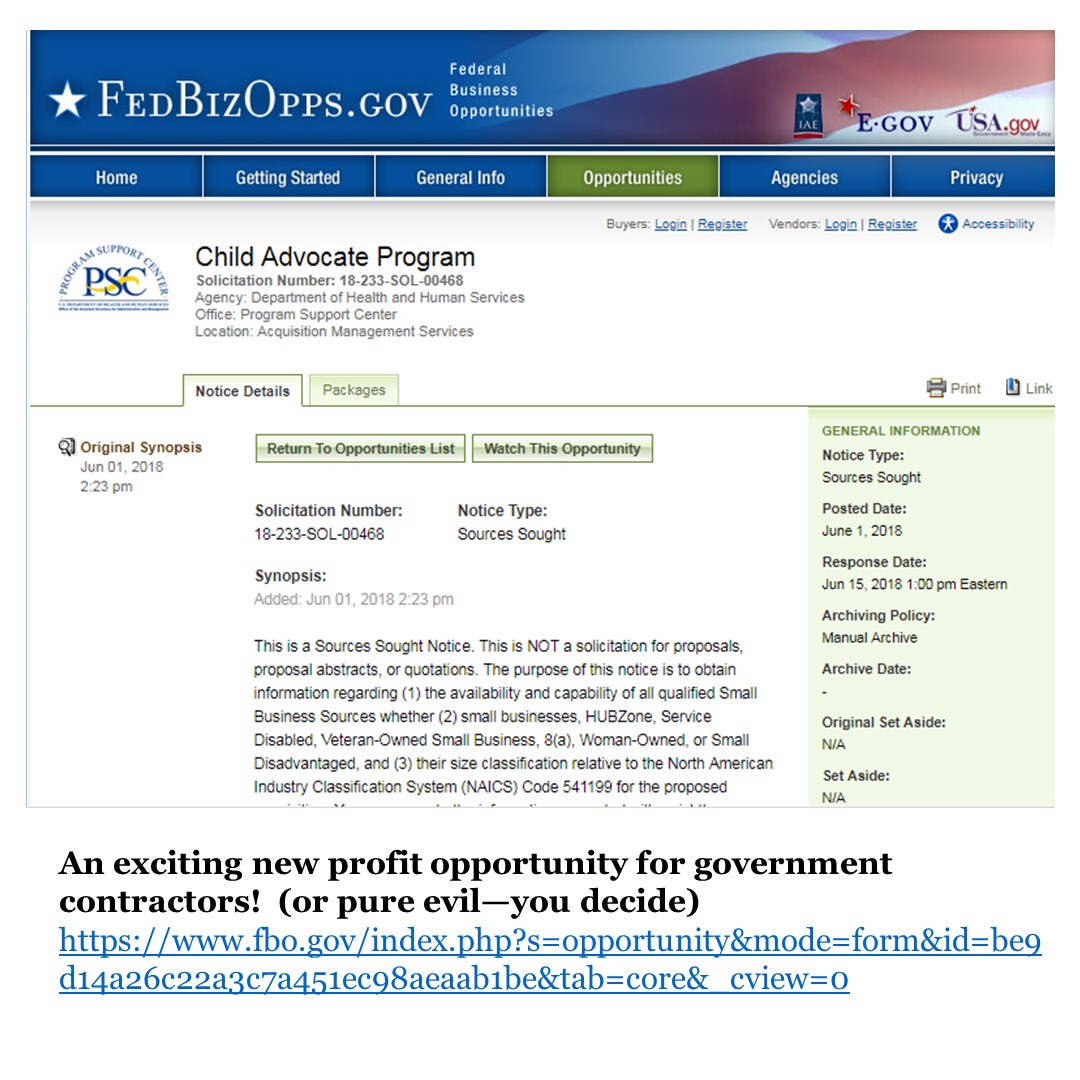
Like human trafficking, it seems that the Trump administration’s new policy also has profit and corporate interests at heart. Who will house and care for these children? That sounds like a pretty lucrative new contract to me. We have already seen how the privatization of prisons has disproportionately harmed people with mental illness. Now the New York Times and others are reporting that military bases have been told to prepare for as many as 20,000 children in coming months. Defense contractors stand to make millions off of these children’s and families' pain.

When I looked at those little shoes of dead children in Dachau so many years ago, I never thought I would live to see an America where Nazis marched openly in the streets chanting “Blood and soil,” or where white supremacists became policy makers. In his stated goal to “make America great again,” President Trump seems to have returned to the noxious idea of Manifest Destiny, which, incidentally, was the only thing I learned about American history in high school. I am now more informed about things like the genocide of native people and the way in which Jim Crow and segregation deprived generations of African Americans of the American Dream white people came to expect.

I now sum up Manifest Destiny like this: God favors capitalist white people of European descent. So we can pretty much take what we want.


Yes, I say “we.” To be clear, I have always been the whitest white girl in any room. Most of my ancestors came here in the 1850s as pioneer immigrants from England and Scandinavia—you know, Norway, not a “shithole” country like Honduras. I’m being sarcastic. I can’t say I don’t see race, because it’s pretty clear that white people like me have enjoyed all kinds of systemic privilege. As Beverly Daniel Tatum, a professor of psychology and expert on race relations, said in an interview with PBS, “For me the relevant issue is not, "Are you racist?" but are you actively working against that system of advantage?”   

I do see race. And when I see race, I see social injustice. This current crisis is no exception. Let’s be honest: We would never let white children be treated like this.


I watched Fox News a few days ago (June 18, 2018) because I wanted to understand why my normally reasonable conservative friends like you were spouting nonsense on Facebook and Twitter about the clearly moral crisis of children being separated from their families at the border.

In the space of just two minutes, I heard the following:
  •  Instead of creating a “media hysteria” about the children separated from their parents, why weren’t journalists focusing on homeless veterans?
  •  The children’s camps, far from being traumatizing, were actually like “summer camp,” and certainly better than what they came from. 
  •  Anyway, what kind of parents would put their children in this situation? Wasn’t it really the parents’ fault?
  •  “The left” just wants open borders and doesn’t respect the rule of law.
  •   Congress should consider changing foster parenting laws so that these “poor children” can be swiftly adopted by loving families who want to care for them (unaccompanied minor refugee children are currently not eligible for adoption—and this is just a whole new and morally appalling level of the White Savior complex  at work, but that is also another conversation).

I don’t know how else to say this: It’s hard to have a reasonable conversation when everything that comes out of the other person’s mouth is a logical fallacy.

On a personal note, you may not know why these border children and their mothers matter so much to me. I feel their pain. As a mother, I have experienced firsthand the trauma of being separated from my children—and I would not wish it on anyone. On December 24, 2012, a family court judge in Idaho determined that my younger two children were not safe in my home. He removed them from my physical custody and placed them with their father. They were seven and eight years old. Before the order, we spent 50% of our time together. After the order, we got to see each other for four hours on Saturdays, with no sense of when, if ever, things would be normal again.

The hearing resulted from a blog post I wrote after the tragic school shootings at Sandy Hook Elementary School, picked up under the title “I Am Adam Lanza’s Mother” by Boise State University’s The Blue Review. I described my then 13-year old son’s dangerous behavior that resulted from his mental illness. Though I also described our family’s safety plan, developed with the help of Child Protective Services, the Idaho judge decided that my children were in imminent danger.

More than five years later, I still wake up in the night shaking, thinking that my children are gone. I still experience debilitating autonomic symptoms including panic attacks. My children also suffered damaging psychological effects from the separation, even though they always knew where I was and that I loved them and wanted them, a luxury that the children detained in border camps do not always have.

In fact, the lifetime harmful effects of childhood trauma  are well documented. The 1998 Centers for Disease Control/Kaiser ACES study tracked the impact of a variety of childhood traumatic events on lifelong mental and physical health. Childhood trauma is correlated with increased risk of neurodevelopmental disorders, emotional and cognitive impairment, risk-taking behaviors, and early death.  Some children younger than five who are separated from their parents develop Reactive Attachment Disorder, a condition characterized by “irritability, sadness, fearfulness and difficulty interacting with adults or peers.” These children are also at risk for developmental and physical delays.

To the argument that their parents are the ones to blame for the children’s distress, I'm taking a page from Attorney General Jeff Sessions and offering an Old Testament rebuttal in King Solomon’s wisdom. When faced with the choice between her child’s death or losing her child to another woman, the mother gave up her child, because a mother will always choose her child’s life. But no mother should have to make this kind of choice.

The British Somali refugee poet Warsan Shire puts it another way: “no one leaves home unless/home is the mouth of a shark/you only run for the border/when you see the whole city running as well…you only leave home/when home won’t let you stay.” (“Home”)

One final note: I know that you are a good mother to your children, and that on a personal level, this atrocity truly hurts your mother’s heart. Listen to the call of your heart. Mothers’ hearts know the truth about what children need. The Trump administration cited the Bible to justify their policy. But we both know that Jesus was very clear about the central moral imperative to care for children: “Whoever welcomes a little child like this in My name welcomes Me” (Matthew 18:5).

Who are we as Americans? Are we welcoming? Are we compassionate? Are we moral? Or do we only extend our welcome and compassion and morality to people who look like us? 

If the choice is making America great for folks who “belong” here or choosing all of us, I choose all of us. We’re America. We can find room to welcome the strangers, as the Bible tells us to, and when we do, we’ll be truly great.


My friend, I understand that you are concerned about illegal immigration and asylum seekers. Like you, I do not believe that open borders are the right solution. But the current administration’s deplorable policy harms children, period. As Americans, we cannot support any policy that harms children. This is a bright line moral test, a Kantian categorical imperative. How we treat the most vulnerable in our midst will define our humanity. In this struggle, I’m siding not with “America First” but with “children first.”

Bye now.  

Thursday, February 15, 2018

Dear Congress: If Mental illness Causes Mass Shootings, Put Your Money Where Your Mouth Is

x
It’s easy to blame mental illness, but we fail to mention that treatment works and recovery is possible for many.

For mothers of teenagers like me, news about a school shooting never gets any easier. We experience the same dread, the same despair, the same fear that someone will attack our children’s school. In between mass shootings, we drill our children on what they would do. We check on their social media accounts. We try to pretend that there’s some sense of safety in a world that always seems full of random, unpredictable violence.

I’m the mom CNN used to call whenever there was a school shooting. And today, one day after 17 children who are the same age as mine did not come home from school because of another mass shooting, I’m angry. Predictably, politicians have tweeted meaningless “thoughts and prayers.” Also predictably, some Republicans have tried to shift the blame for the latest massacre to the isolated actions of a “mentally disturbed individual.”  

After the Sandy Hook Elementary School shooting five years ago, I shared my story of parenting a child with violent behavioral symptoms of a then-undiagnosed mental illness in a viral essay entitled “I Am Adam Lanza’s Mother.” In that essay, I wrote, “It’s easy to talk about guns. But it’s time to talk about mental illness.” 

Now, I’m concerned that we are having the same blame and shame conversation without any meaningful action, as this viral Facebook post shows.  

Today, with the correct diagnosis (bipolar disorder) and treatment that works, my son Eric lives in recovery. In 2016, he even gave a TEDx Boise talk about his experiences.  Eric is a normal high school senior who, like many of the Parkland, Florida students, is planning for college next fall.

Today, I feel that blaming mental illness for an epidemic of violence in the wake of so many mass shootings has become a meaningless trope. If politicians and the National Rifle Association really believe that mental illness causes mass shootings, it’s time to put their money where their mouth is. Here are a few suggestions:

1.       Provide funding for research into treatments and cures, perhaps by donating the millions of dollars that the National Rifle Association gives to their campaigns.  

2.       Continue to support parity for mental and physical health, currently required by the ACA but already under threat in my own state.  

3.       Stop blaming children and their parents for the appalling lack of community mental health services and supports.  

4.       Understand that when treated, people who have mental illness are no more likely to be violent than anyone else. Treatment works and recovery is possible.  

5.       Adopt reasonable and bipartisan gun control measures that focus on suicide prevention, since more than 60% of deaths by gun violence in the U.S. are completed suicides, a tragedy that disproportionately affects the brave men and women who serve in our military.  

Most people can agree that universal background checks and allowing the government to track gun violence statistics (currently prohibited by federal law) are good first steps to better understanding and controlling our nation's clear gun problem.

To be transparent, I live in Idaho, a gun-loving state. I grew up in a family that hunted, and my brothers taught shooting sports at Boy Scout camp. I have enjoyed shooting sports in the past. While I do not personally have guns in my home because of my son’s illness, I know many responsible gun owners, some of whom live in recovery. 

Yes, it’s true: people who have mental illness can be responsible gun owners, which is why mental health advocacy organizations including the National Alliance on Mental Illness believe that “Federal and state gun reporting laws should be based on these identified traits, not mental illness.”   

People who are in treatment for mental illness and are compliant with treatment should not be treated any differently than anyone else. To focus on mental illness as the sole cause of mass shootings is a clear example of the pervasive discrimination and fear in our society. In fact, while it’s true that at least one-third of mass shooters seem to have had an untreated mental illness, a more common predictor of this kind of violence is a history of animal abuse or domestic violence, as is the case with the Florida shooter. Both of these deplorable behaviors are actual crimes, and both of them should require immediate intervention including loss of gun rights.

But mental illness is not—and should not be—a crime.

It’s time to act.  Build the community mental health treatment centers. Fund research into cures. And most importantly, stop blaming by association the millions of good people who live in recovery for the violent actions of a few.